

The Secret History of Knocking on Wood
Most of human nature is never written down — and machines can't learn it from text

My younger daughter, Nava, turned two last week. Among her favorite phrases are “No, Nava do it” and “what da HECK.” Her favorite music, by a wide margin, is Elton John. And her favorite gesture is a hearty, full-body nod. She deploys this repertoire with enormous humor, precision, and grace.
I love being a parent. The thing I find most fascinating about the experience is how it throws a mirror not just on one’s own childhood, but on all of human nature. It’s an obvious point, but one that I never thought about before having kids: all newborn babies are always the same, everywhere. And then, slowly but surely, they become not the same. As cultural and family influences accumulate like sedimentary layers in these tiny personalities, you can see nurture reshaping nature in a deeply embodied, physical way.
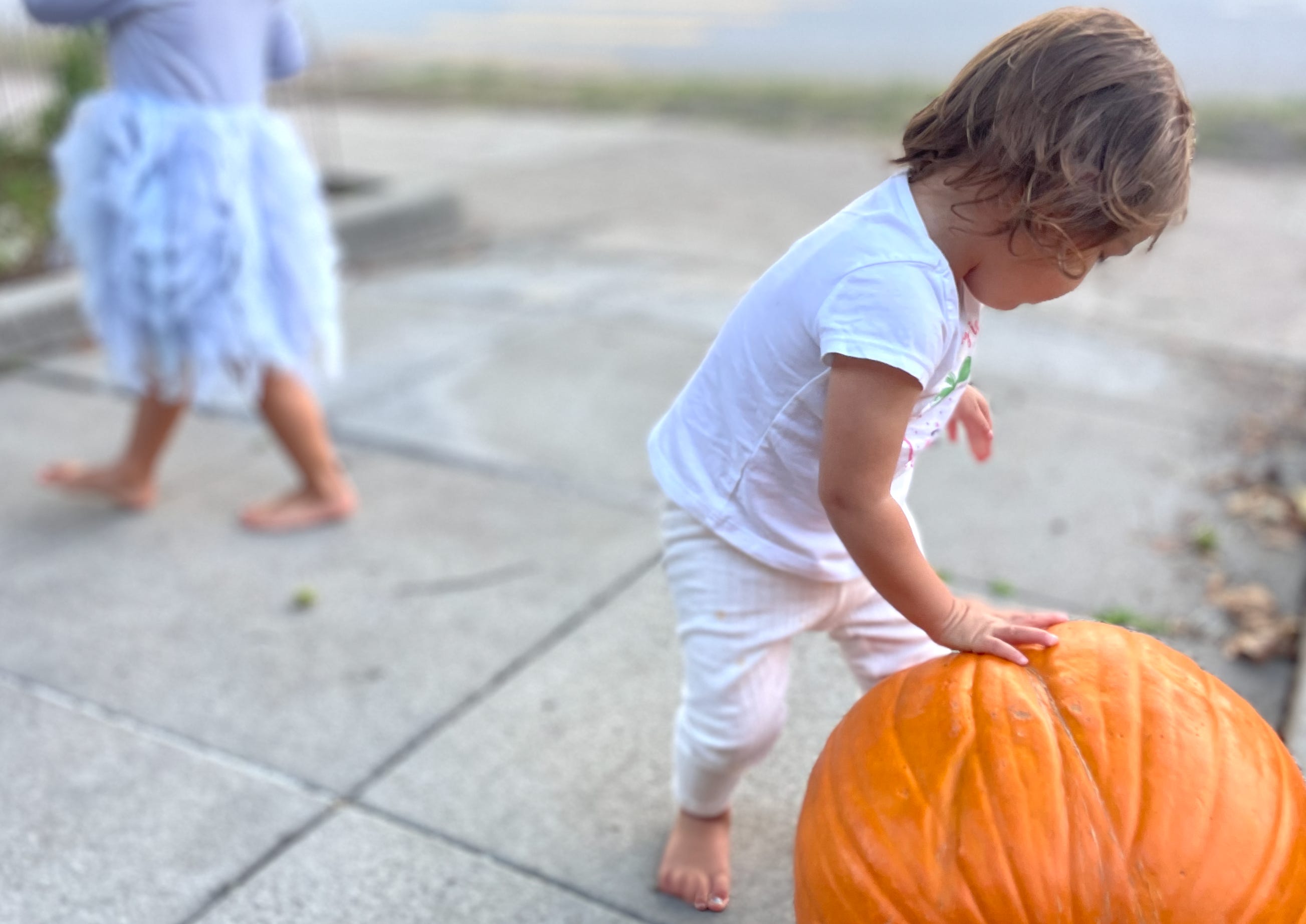
One thing that Nava has got me thinking about is the deep history of gesture. Gesture exists on the borderland between nature and nurture. Certain physical actions are so universal that they communicate effectively not just across human societies but across species: bared teeth, for instance. Other gestures encode more specific cultural patterns, but do so in a way that is more expansive than language.
A few months ago, for instance, I watched my mother-in-law (who was born and raised in a village in northern Iran) teach Nava how to knock on wood for good luck. I hadn’t realized this was so widespread a practice until I checked Wikipedia and found that variants exist in Bulgaria (chukam na dǎrvo), Georgia (kheze daḳaḳuneba), Indonesia (amit-amit jabang bayi), Norway (bank i bordet ) and some two dozen other countries.
Why? Could we trace embodied behaviors through history just as anthropologists can trace, say, legends or etymologies relating to magical blacksmiths or slaying serpents?
What I found is that written evidence for knocking on wood (and for the history of gesture as a whole) is remarkably sparse. In the Penguin Guide to Superstitions, folklorist Steve Roud offers a skeptical take on the provenance of knocking on wood due to the near total absence of written records about it:
The two most popular explanations of origin are that the belief goes back to pagan times when we believed in tree spirits, or that we are invoking Christ’s protection by referring to the wood of the Cross. The former is nothing but guesswork, based on the conviction that all superstitions must be ancient, and it has the usual problem of spanning thousands of years with no evidence at all of its existence, or, for that matter, any evidence that ‘we’ ever believed in tree spirits.
Roud then ventures a theory of his own: the custom, he argues, probably developed from a children’s game called Tig-touch-wood that was popular in early 19th century England.
If true, the practice of knocking on wood for good luck is actually surprisingly new.
The “Knocking on Wood” Wikipedia page mentions Roud’s conclusion, and this claim of a 19th century origin has circulated online as the final say on the matter. If you go back to the original, though, Roud’s proposal actually ends on an ambivalent note: “Before this theory [of 19th century origins] can be finally accepted, however, an examination of the history of European forms of this custom would be advisable.”

This is where historical data visualizations — of the type Claude Code can now produce on cue — can come in handy. I downloaded a scientific paper about knocking on wood along with the crowd-sourced Wikipedia list, then provided it to Claude Code and asked it to plot the data on a three.js globe. Here’s the interactive version and the GitHub page.
What we see is that there are in fact two entangled traditions of “knocking on things for good luck”: touching iron, and touching wood. We also find that they are widely distributed, but also have a pretty clear cluster around the Mediterranean and Europe.
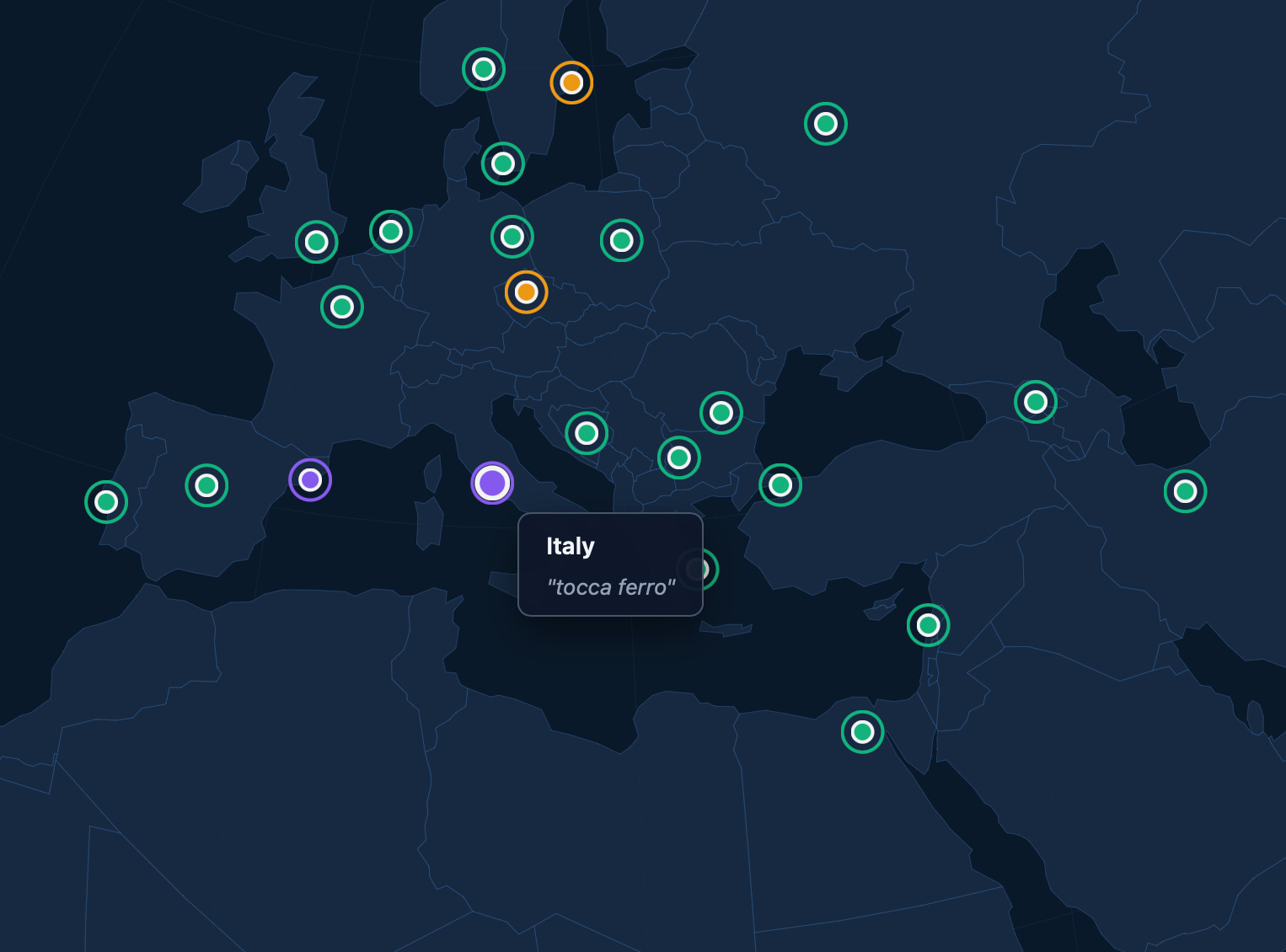
And, although it is difficult to find references to knocking wood for good luck before the nineteenth century, it turns out that this is not the case for touching iron — the “tocca ferro” of Italy, shown above.
The upshot: I struggle to imagine a process whereby an obscure English children’s game somehow inspired gestural customs in Georgia, Egypt, Russia, and Iran within less than a century. It seems more reasonable to me that these customs might instead originate in an ancient Mediterranean tradition of apotropaic magic, or charms intended to combat bad luck.
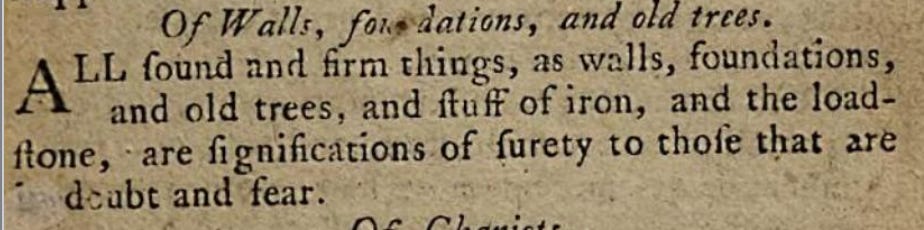
For instance, here’s a snippet from an early modern translation of an Ancient Greek dream interpretation text, the Oneirocritica of Artemidorus:
This put me in mind of a recent New Yorker article by the anthropologist Manvir Singh. The article is about the efforts of linguists and folklorists to reconstruct the Proto-Indo-European mythology which links folk tales and gods from India to Ireland. The serpent-slaying storm god, the Sky Father, the Divine Twins: these figures mutated and multiplied across cultures but retained their essential forms.
Might the linkage between “stuff of iron” and “surety to those that are in doubt,” likewise, have an ancient pedigree via gestural traditions? Notable here is the fact that one of the oldest known fairy tales involves iron-working: “The Smith and the Devil.” A study from 2013 concluded that this story template, which associates iron-working skill with magic, was traceable back at least 6,000 years.
Then again, maybe it all really does go back to Tiggy-Touch-Wood. The truth is that we really do know shockingly little about the history of gesture.
Given recent developments, that should probably change.
Things humans don’t write down
The history of most human gestures is never written down, precisely because it is something we learn before literacy or memory and thus something we take entirely for granted.
Another example: why do so many languages implicitly view the right hand as good (for instance, associating the direction right with the ethical concept of rightness) and the left hand as bad, maladroit, sinister?
I found this article on the subject, and decided to turn that data into a visualization, too.

The author of the article, the German anthropologist Wulf Schiefenhövel, writes:
I find it plausible to think that early humans began to observe, to feel the difference between right and left, and to ascribe qualities like “clumsy,” “awkward,” “crooked,” and “tired” to the less dexterous hand (it is interesting that these very terms still show up prominently in today’s modern languages) and correspondingly positive qualities to the right hand preferred by the majority. This process, intertwining emotion and cognition, can well be expressed in the terms of embodiment... The semantic values with which the terms for left and right are charged in almost all the languages examined for this survey could have their origin in this very process: embodiment turned into words.
Singh’s New Yorker article ends by asking what these sorts of searches for common origins tell us: “that our wild, warring species shares something irreducible at its core.”
But they also point to something we don’t share with the other new pseudo-intelligences emerging today: machine intelligence.
So many of our latent assumptions about selfhood, reality, and consciousness flow from our embodiment as physical beings and from the deep histories of gesture and other forms of implicit knowledge.
Why do I, my mother-in-law, and Nava all knock on wood? None of us really know. Perhaps it’s a legacy of the Bronze Age; perhaps it’s a meme from Victorian Britain. What is certain is that it’s not something a robot with an LLM-based brain is going to do habitually, just as robots will never share in mental frameworks deriving from quirks of our physical architecture, like handedness.
The history of gesture, in other words, bears directly upon the question of AI alignment. Humans across cultures and times intuitively maintain a set of semantic and ethical judgements rooted in our physicality, our learned and instinctive gestures, and the affordances of the natural world. There is just something “knockable” about wood. LLMs don’t have childhood memories of jumping over cracks in pavement or their grandmother teaching them gestures. Moreover, such things are not really in their training data either.
For this reason, machines without our embodied experience may think they are aligning their behavior with human norms, but they will never be able to feel the physical basis for some of those norms.
Unless, as with Nava, we teach them.
Can world models touch grass?
I have been thinking a lot lately about “diachronic AI” and “vintage LLMs” — language models designed to index a particular slice of historical sources rather than to hoover up all data available. I’ll have more to say about this in a future post, but one thing that came to mind while writing this one is the point made by AI safety researcher Owain Evans about how such models could be trained:
One challenge is having enough training data. Another is that the training data needs to be free of contamination. For a model trained up till 1900, there needs to be no information from after 1900 that leaks into the data. Some metadata might have that kind of leakage. While it’s not possible to have zero leakage - there’s a shadow of the future on past data because what we store is a function of what we care about - it’s possible to have a very low level of leakage, sufficient for this to be interesting.
You can include multimodal data like images. There’s something strange about including images when going back to Roman times or 1700 because while they had texts, they didn’t have digital images. However, this is acceptable for some purposes. You’d want to avoid leaking information that could only be known in the present. You could include things people at the time could see and experience themselves. For example, there may be no anatomically accurate painting in Roman times of a bee or an egg cracking, but you can include such images because people could see such things, even if they weren’t part of their recorded media. You could also have pictures of buildings and artifacts that we still have from the past.
That last observation, about training vintage language models on images of the physical world, is, I think, a fascinating one.
Consider Nava. Another of her favorite phrases is “I seein’ it!”
And reader, let me tell you: Nava is, indeed, seeing it. Really seeing it.
Whatever it happens to be, Nava is (so it seems to me) seeing it with a freshness of perception, a joyful richness of observation, that my 40-year-old eyes simply cannot equal.
I suspect rather strongly that premodern people, too, experienced the physical world more acutely than I do, simply because my brain has been stewing in dopamine-spiking stimuli for four decades now, rarely pausing to touch the proverbial grass. Don’t get me wrong: I like the outdoors a lot. But my waking existence is spent mostly indoors in highly artificial spaces, whereas humans have typically spent the vast majority of their time outdoors in nature. Consider my ancestors, who, as best I can tell, were primarily illiterate peasants and smallhold farmers. They spent a significant proportion of their waking hours literally touching grass.
I wonder how much this world of gesture and of the senses — the things we see, feel, hear, smell, and taste — is implicitly embedded in the textual corpora we humans produce and in the value judgements we derive from it. When we hold truths to be self-evident, is a sense memory of the physical act of holding somehow contributing to the meaning (is it, in fact, helping to “carry” or “support” that meaning?)
Owain Evans’ idea of feeding a historical LLM non-anachronistic images is, I think, well worth doing. But it’s also worth expanding on further. Would it be helpful, when training a historical LLM, to simulate dream imagery based on premodern themes? What about audio of birdcalls, which were far more prominent in the audioscapes of premodern people? What about taking it on a walk through the woods?
Would an AI model trained on such things be not just more authentically premodern, but more authentically aligned with implicit human values?
The converse is also worth asking — whether simulating artificial environments (for instance a 3d representation of a Youtube video) might have unintended negative consequences. Fei-Fei Li’s startup World Labs, which aims to make the leading “world model” — an alternative to language models based on tokenizing physical space rather than words — recently raised a substantial amount of money. As consumer-facing robots become more plausible, the business case for such a model is obvious. But what physical spaces are “world” models actually being trained on? The contemporary physical environment, sound-proofed, plastic-coated, and artificially-colored, is radically different from the environment that Homo sapiens evolved to excel in.
This sort of thing is why I think historians need to be more active in technical discussions and decision-making about emerging technology. Everything about our current world is different from the premodern world that our ancestors inhabited. The past truly is a foreign country. But we carry fragments of that foreign world with us in our physical selves, in the gestures and other implicit knowledge we teach our kids. We take it for granted that there are aspects of being human which are never written down and which are unknowable unless you experience them.
AI systems, locked in their data-worlds of text or simulated 3D environments, never even come close to this implicit knowledge. Not yet, at least.
Weekly links
• “What not reading does to your writing.” Lincoln Michel is one of my favorite chroniclers of life as a professional writer, and the point he concludes on here really is the simplest, most effective advice I can give to anyone who wants to write better: “The best way for this author to improve their writing is simple. They should read a few good books.” I notice it in myself. When I am not actively reading fiction, my writing gets more flat.
• “Archaeologists Say They’ve Identified Traces of a 2,000-Year-Old Love Note Still Etched Into a Wall in Ancient Pompeii.” (Smithsonian).
• Every time I teach world history, I make a point of showing things like the above to my students and reading them Philip Larkin’s “An Arundel Tomb”:
Time has transfigured them into
Untruth. The stone fidelity
They hardly meant has come to be
Their final blazon, and to prove
Our almost-instinct almost true:
What will survive of us is love.
Singapore and parts of China has touch wood for fortune and protection but not knock. North American Chinese people hang a round mirror facing the front door for protection against evil but not Chinese people in China because that's bad feng shui. Left hand is the clean hand in certain parts of Buddhism (I last heard of that in a Buddhist temple in Sichuan province), while right hand is the dirty hand, the reasoning is that because your left hand is clumsy you don't use it to wipe your ass or hold a cleaver.
I witnessed all those and had the people explain them to me, but I can't find anything online so people accused me of lying and making things up.
Heck, I ate jiaozi with rice/glass noodles in it all my life and when I wrote that in a story someone on the Internet accused me of lying/making it up because they never saw that and it doesn't show up on google search. I ate that jiaozi all my life, my grandfather and many relatives made and still make jiaozi that way. Other people from that region still make jiaozi that way.
It's not just a matter of machine can't learn when there's no text, humans should also stop judging things based on the existence of text. Because I'm pretty sure that's discrimination against small groups with traditions never written down. I shouldn't need the existence of an academic paper to prove the jiaozi recipe passed down over many generations.
Often when I read your writing, I think of something I want to say back to you, and surprisingly often, you bring it up in the next paragraph. Touch grass, Fei Fei's research, are only the most prominent examples for me in this piece. But you didn't ever bring up multiple origins, which would seem the most obvious first hypothesis about touch-benedictions.
I talked to bees before I ever learned there was tradition of "telling the bees" and your daughter likely has dozens of similar habits she was not taught by you, most of which she might forget by age 3 and never do again. Not sure how to think about this but it might be there is a natural or more universal animism, and then a diverse cultural response: like the PIE word h₂ŕtḱos, meaning bear, which developed into Latin ursus and Greek arktos. Then the many euphemisms from honey eater and brown one that different cultures adopted to prevent saying the name of the feared predator. The talking to and touching, in this analogy, is an emergent behavior but the specific form (bees or figurines and wood or metal) becomes ritual with a literature that can be traced historically.