


Centuries of Childhood
The history of childhood is one of multiplicity — so why do we tell parents such simplistic stories about it?

One of my favorite documentaries is the 2010 French film Babies. Told without narration, it follows four babies in four cultures: Mongolia, Namibia, California, and Japan.
Here’s the trailer:
I first watched it in 2021 with my wife Roya, when she was in her third trimester of pregnancy. Those months leading up to the birth of our daughter Yara almost felt like we were studying for an exam. Watching Babies was just a small part of a regimen that included close-reads of Emily Oster, endless scrolling of the various parenting subreddits, and debates about attachment parenting, sleep training, screen time, and everything in between. We researched sleep sacks and Snoos, white noise machines and bottle warmers.
And, along the way, we both encountered an assumption that seemed to structure almost everything else. This is the idea that there are two kinds of parenting, “modern” and “traditional”… and that there is something distinctly isolating, atomized, and even damaging about modern parenting methods.
During this same period, I was in the thick of writing my book Tripping on Utopia, a history of the origin of psychedelic science that centers on the anthropologist Margaret Mead and her world. And Margaret Mead was utterly obsessed with babies. So it was partly as a first time parent and partly as a historian of anthropology that I read articles which said things like this: “Historically, premature infants would be consistently attached to their mothers” or trumpeted the “millennia-old methods of raising good kids that made American parenting seem bizarre and ineffective.”
This valorization of “traditional” or “historical” parenting wasn’t just visible on parenting blogs. References to the supposedly more supportive childrearing practices of “premodern” societies abound, for instance, in peer-reviewed articles in pediatrics journals:
“In traditional societies, babies are kept near their mother.” (source)
And in Jared Diamond’s best-selling book The World Until Yesterday:
“children [in traditional societies] are brought up... with constant security and stimulation... and the minimal amount of physical punishment.”
These claims don’t just circulate in the United States or even in the West as a whole. For instance, this statement appeared in The Times of India last year: “In hunter-gatherer societies, communal living ensured that infants were never alone, receiving proximate, sensitive, and responsive care.”
That article’s headline? “Stone age babies received better parenting, here's where modern parenting fails.”
In so many of these “pop history” approaches to parenting, there is an assumption that “traditional,” “hunter gatherer” or “Stone Age” parents were simply better. More caring, more sensitive, less violent, and less neglectful.
Does that framing even make sense, though?
The problem with this kind of thing is that there simply is no such thing as a “standard” traditional or premodern society. And hence, all this talk of historical or traditional parenting creates an illusion of standardized practice when in reality there is nothing but endless variety.
At first glance, this sounds like a truism: different societies are, well, different. But the sheer degree of difference doesn’t come across until you really dig into the historical and anthropological record (something which, I find, very few parenting advice-givers tend to do).
As an example, let’s take Margaret Mead’s findings from her field work in 1930s New Guinea.
This is a passage from Tripping on Utopia that I ended up cutting from the final draft of the book. It is based on Mead’s notes and published memoir of her time among the Mundugumor people in New Guinea’s Sepik River region:
Reo Fortune [Mead’s husband and research partner at the time] was fascinated by violence, secrecy, and, above all, by sorcery. He found all three in abundance among the Mundugumor. Village life was mostly peaceful, but it was interspersed by moments of terror. The Mundugumor believed in a world in which the ghosts of their ancestors judged them at all times, doling out supernatural punishment for the violation of rigidly-observed taboos. These taboos governed everything, and those who broke them were severely punished. Reo joined in with gusto, taking part in ceremonial meetings from which women were barred. Mead, meanwhile, set about befriending what she called the “deviants” of Mundugumor society. Her closest contact was a man named Omblean, who Mead found fascinating because he had learned “ever rule and every loophole through which intelligence could outmatch brute strength.”
Among the Mundugumor, brothers and sisters were conceptualized as belonging to entirely separate family groups, or “ropes.” They typically did not communicate. The Mundugumor children were, like all children, delightful to Mead, a respite from what she perceived to be the humorless and rigid world of the adults. But here, too, was violence. Mead’s notes from this period are littered with documentation of infanticide. The Mundugumor’s “rope” system meant that fathers considered themselves to be in the same family only with their daughters, to whom they developed close bonds. The reverse was also true: mothers were intimates with sons, but not their daughters.
As a result, if a child of the “wrong” gender was born, it was not unheard of (by Mead’s telling) for a father to abandon a son, or a mother a daughter. The children were deposited, like Moses, in tiny vessels of woven bark and left to drift along the river until they either died or were adopted by strangers.
Attachment parenting, this is not.
Mead encountered a radically different culture living just a day’s journey from the Mundugumor. The Mountain Arapesh, as Mead called them, struck her as intensely devoted to their children’s well-being in a way that was almost the polar opposite of the Mundugumor.
But here, too, things were incredibly particular. The Arapesh had a complex system of “birth payments,” for instance, which shaped the relationship between father, mother, daughter, and son throughout the rest of their lives.

Back to the Babies documentary, which I suspect Mead would have loved.
At first, it might seem to reinforce the idea that there is a chasm between “traditional” and “modern” parenting. If you watch the trailer, for instance, you can that the editing sets up an implicit comparison between the Mongolian and Namibian families, on one side, and the families in San Francisco and Tokyo on the other.
The babies in San Francisco and Tokyo are almost entirely living in human-created worlds, whereas the Mongolian and Namibian babies are surrounded by animals, earth, and open sky:

But if you watch the complete film — and I encourage everyone reading this to do so, because it’s wonderful — what ultimately comes across is how distinct each society is. To throw the experiences of these babies into buckets labelled “modern” versus “premodern,” or “artificial” versus “natural,” is to perform an extreme simplification.1
Now, it might be argued that these were all babies living in the twenty-first century, and so many of the claims about attachment parenting, co-sleeping, and other childrearing debates rest on assumptions about historical societies.
But here again, the perspective of anthropologists who worked in decades past — like Mead — is valuable. Mead, it turns out, was involved in the creation of a documentary that is almost like a mid-20th century version of Babies. That film, Four Families, was released in 1960 and followed parents in Canada, France, India, and Japan.
You can watch it here thanks to the Internet Archive.
![[crop output image]](https://substackcdn.com/image/fetch/$s_!lgTL!,f_auto,q_auto:good,fl_progressive:steep/https%3A%2F%2Fsubstack-post-media.s3.amazonaws.com%2Fpublic%2Fimages%2Fc5142cfc-d4b9-47fc-aee2-922c7d9e56f8_501x344.gif "[crop output image]")
This shot from Four Families might come as a surprise to some contemporary advocates of co-sleeping. Although it’s sometimes claimed online that “individualistic” western societies are the only ones in which mothers and babies don’t typically sleep in the same bed, that isn’t what the history or anthropology of childhood actually shows us.
And as for the books about the virtues of “French parenting”? To me, the most striking thing in Four Families is the glimpse into French family life in a rural area circa 1960. To anyone who’s lived in Mediterranean Europe, it would not be surprising that a French family (then or now) would give a small glass of wine at dinner to their children.
But I have to admit to being surprised when the entire family in this film — including the baby! — begin drinking alcoholic cider for breakfast:

The baby is just sipping, but mother and father are positively tossing back the glasses. Keep in mind, this is not dinner or lunch. This is the process of packing the kids up for school!
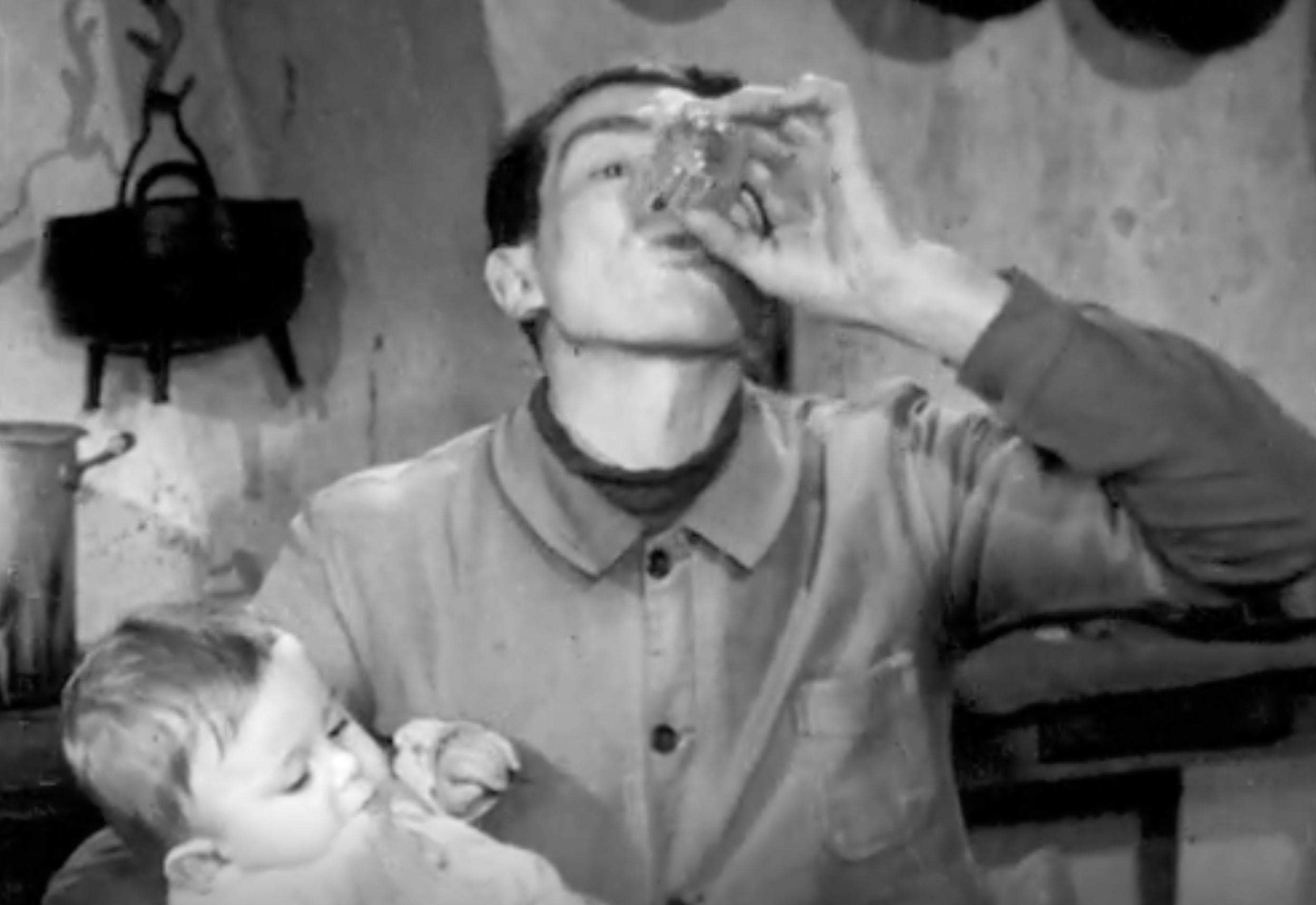
There are many charming and quaint moments in Four Families, and all of the families are portrayed as loving. I’m not here to judge their cider-chugging ways. But there is one fundamental fact of life in the premodern world (and even of life as late as 1960) that I think most parents today would be appalled by.
Babies just died way more often.
Like way, way more often.
In the France of 1960, for instance, the infant mortality rate was roughly ten times higher versus today.
And that’s not all. If you go back to the 19th century, the numbers are once again an order of magnitude higher. In Southern Germany at the end of the 19th century, for instance, roughly 30% of infants died before their first birthday:

And it’s not just infant mortality. Childhood before the twentieth century was generally appalling by modern standards. With the exception of a few halting efforts, child labor laws simply did not exist. But more than this, it’s debatable whether the idea of childhood itself even existed.
As the French historian Philippe Ariès wrote in his book Centuries of Childhood:
In 1600 the specialization of games and pastimes did not extend beyond infancy; after the age of three or four it decreased and disappeared. From then on the child played the same games as the adult, either with other children or with adults. . . . Conversely, adults used to play games which today only children play.
I remember reading Ariès’ book in a graduate school seminar and pushing back almost instinctively against this idea that key aspects of the concept of childhood were a modern invention. Surely it had to be universal to love one’s baby, to cherish and protect the innocent early years of their life, and to set them apart from the harsh world of adulthood.
Others in the grad seminar agreed, and when we reached for evidence to back us up, it wasn’t hard to find. Ariès’ take on childhood remains controversial, and there are literally hundreds of scholarly articles debating it.
And yet: if you dig into the historical sources, you really do find some truly outlandish stuff. One example: it was a common practice in some parts of premodern Europe for peasant children to be nursed by goats or donkeys.
And then, of course, there are the six-year-old Welsh coal miners.
In a 2020 article in the American Historical Review, Sarah Maza wrote:
While flesh-and-blood historical children can be elusive, the child turns up everywhere as a multivalent symbol: signifying the past, the future, the sacred, innocence, vulnerability, and life itself, the imagined child has a unique ability to mobilize adults to act on their most emotionally urgent agendas.
Today, in an age of distraction and alienation, it makes sense that parents focus on visions of childhood defined by cultural cohesion and constant social contact. But mobilizing a cartoon version of history to support such a vision does more harm than good. In my experience, it adds to the stress of parents who compare themselves to an idealized, and often frankly inaccurate, concept of what “authentic” parenting should be.
And it also, I think, contributes to what I think is one of the most toxic trends in how we think about history online: the backwards-looking “look at what we lost” discourse about a supposedly golden past that modern life destroyed.
Did we ever have a world where most kids grew up happy, healthy, and fulfilled, in nurturing communities surrounded by loving caretakers?
Unfortunately, the answer is no.
I can say that with unusual certainty, because roughly one third to one half of all children either died or suffered disabling illnesses in childhood in all premodern societies we have documentation for. Thus a significant proportion, even a majority, of possible childhoods in the past were not fulfilled, because they were not fully lived at all.
When I think about the lives that my two daughters will live, there is an enormous amount of uncertainty. But I’m reasonably sure their childhoods, like those of the four babies in the French documentary, will be far better than the average across all past human childhoods.
There are many things to worry about as a parent in 2024, but at least I can feel good about that.

Weekly links
• The UK edition of Tripping on Utopia is available now from Footnote Press. If you’re in the media or interested in reviewing it, please get in touch with me for a review copy.
• I found these snippets from Francis Ford Coppola’s “Godfather notebook” utterly fascinating (Noted).
• I can’t remember how I found it, but this PhD dissertation about “law enforcement in Ptolemaic Egypt” is just begging to be adapted into a historical detective novel.
If you received this email, it means you signed up for the Res Obscura newsletter, written by me, Benjamin Breen. I started Res Obscura (“a hidden thing” in Latin) to communicate my passion for the actual experience of doing history.
If you liked this post, please consider forwarding it to friends. I’d also love to hear from you in the comments.
For instance, the Mongolian family reveals a form of childrearing that is virtually the opposite of “attachment parenting.” This is a kid who spends a lot of time alone, with no parents in sight. The filmmaker himself said that this was his main takeaway from the experience of making Babies: “We are too concerned in the West about letting the baby get bored. They need to get bored. They need to have time by themselves. They need to get away from material goods. Maybe get back to simpler stuff. [That] is what I learned as a father by watching this Mongolian and Namibian baby having virtually nothing but flies and cows and grass and wind.”
As proof of your main argument, you glide from evaluation of parenting practices to infant mortality rates, and apparently hope that no one will notice. Infant mortality is a medical problem, and has to do primarily with hygiene and vaccination against childhood diseases, not parenting styles. I suppose one could reach and point to parents who withhold vaccinations from their children, but that's quite a stretch. Either write about parenting styles *or* innovations in medicine, but don't confuse the two when dubiously asserting the superiority of modern life and practices.
As for the assertions about people's idealizing the past, that is a ridiculous straw man. Almost no one fits that caricature, and it is in no way an idealization to claim, correctly, that in making "progress" we have gained certain things, and lost others.
Love “Babies” !
I certainly went a bit crazy trying to research “old ways” once my daughter was born. Actually https://evolutionaryparenting.com had some good articles with historical info if I remember correctly.
Everyone was telling me to sleep train our daughter (I refused) or not to contact nap because she won’t fall asleep on her own (not true, at least for her), etc. Drove me a bit crazy. I think at least what I’ve learned so far, the most important thing, listen to your “gut”. If your brain and body is telling you to keep your baby close, then do so. The internet makes babies sound like robots with suggested sleep schedules, etc. Just cause you’re young doesn’t make you more “trainable” or less complex.
I’d also recommend reading “Remembering the Pheasants” by Patrick Joyce.
And 100% about the footnote letting kids be bored. We all grew up without phones/tablets etc. we survived!